

Why Tropical Field Stations Might Be Our Best Bet for Saving Biodiversity
A new global survey shows just how powerful (and vulnerable) these outposts of science and conservation really are

Years ago, I found myself deep in a Tropical Rainforest, drenched in sweat, covered in bug bites, and trying to coax a broken solar battery back to life while howler monkeys roared overhead. We were short on supplies, low on fuel, and out of satellite signal. But I remember thinking: this is still the most important place I could be.
We weren’t there just to study wildlife. We were keeping watch. Over poachers. Over the weather. Over the forest itself.
These small stations might look like a cluster of tin-roofed cabins and a few tarps stretched between trees, but they’re more than that. They’re nerve centers. And if you’ve worked at one, you know they’re also lifelines for science, local jobs, and the ecosystems we’re all hoping to preserve.
That’s why I was so relieved, and a little surprised, to read a recent paper in Conservation Letters that finally puts numbers behind what many of us in the field have long suspected: tropical field stations are one of the best returns on conservation investment out there. In other words, they punch way above their weight.
Led by Dr. Timothy Eppley and over 200 co-authors (yes, really), the study looked at 157 field stations across 56 tropical countries. These stations mostly support primate research, but their impact goes far beyond.
The goal? Figure out whether these small, often-overlooked hubs are actually helping protect biodiversity and whether they’re worth the money they cost to run.
Spoiler: they are.
What the authors did
To get the data, the researchers sent out a detailed survey to field station leaders. These were people with boots-on-the-ground experience: directors, principal investigators, and long-term staff. The survey covered everything from staffing and budgets to deforestation and research output.
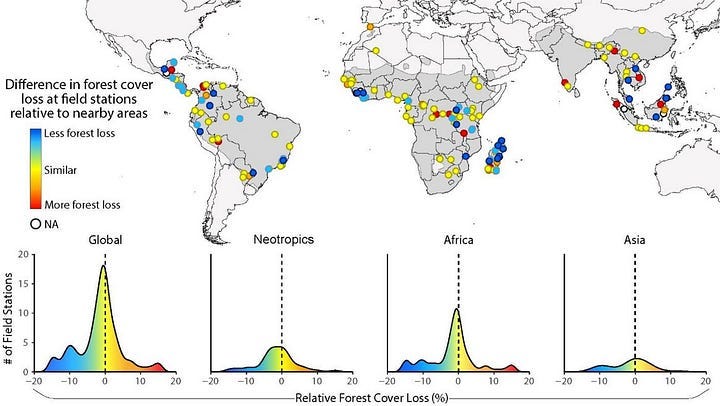
They then used satellite data to compare forest loss around each field station to similar “control” areas nearby without field stations. They also mapped which threatened or vulnerable species’ ranges overlapped with the field stations.
It’s the kind of hybrid work that combines hard data with lived experience; something I’ve learned is absolutely crucial when you’re trying to make a case to funders or policymakers.
The findings: Small stations, big impact
Let’s start with the headline: areas with field stations lost 17.6% less forest cover than comparable sites. That’s not a rounding error. That’s meaningful protection. The difference was even more remarkable in parts of Africa at over 22%.
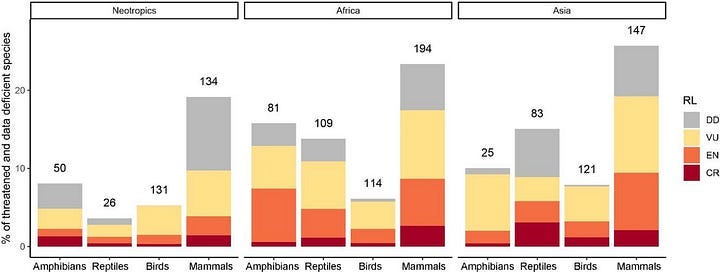
It’s not just about trees. The stations surveyed overlapped the ranges of more than 1,200 threatened or data-deficient species, including 475 mammals and 366 birds. That means they’re monitoring and protecting some of the world’s most vulnerable wildlife, often in places with little to no other conservation infrastructure.
And the kicker? Most of these stations do it on a shoestring.
Over half operate on less than $50,000 a year, which is tiny compared to what it costs to manage most formal protected areas. The estimated cost per square kilometer of field station influence was just $637/year. A bargain, by any conservation standard.
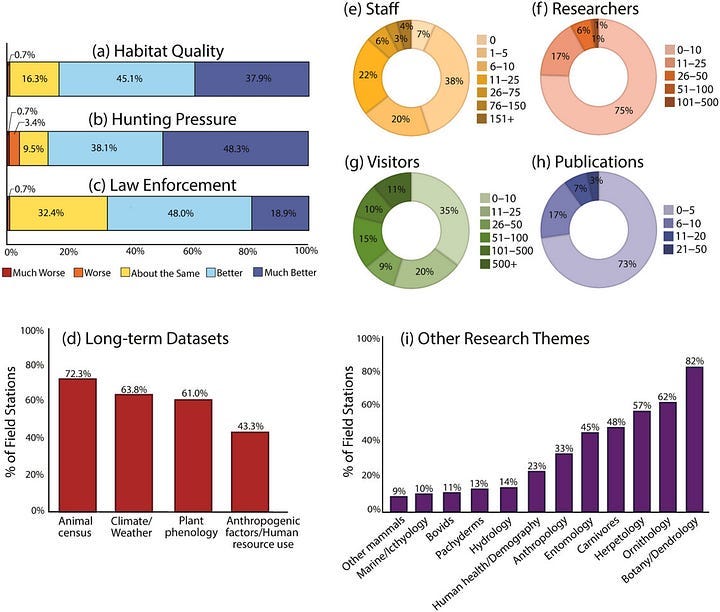
Even more telling: 83% of station leaders said habitat quality was better around their site than in surrounding areas, and 86% reported lower hunting rates. These aren’t just anecdotes. That’s consistent, large-scale feedback from people who are there every day.
More than conservation: Jobs, research, and resilience
There’s something else field stations do that’s often overlooked. They hire locally. In fact, 93% of the stations surveyed employed local community members.
That’s not just good for the economy; it’s critical for long-term conservation success. When locals benefit from having the station around, they’re more likely to support and defend the forest themselves.
The stations also support a constant flow of science: around 1,255 scientific articles a year come out of these sites, not to mention thousands of students, volunteers, and early-career researchers who pass through and learn the ropes of fieldwork.
I was one of them, once. I’ve met people in the field who taught me more in two weeks than I learned in some semesters.
COVID hit hard — and they’re still recovering
Like a lot of conservation efforts, these stations took a serious hit during the pandemic.
Nearly half had to shut down partially or completely. And 50% of stations reported having less funding in 2022 than they did in 2019. Some still haven’t bounced back. That’s worrying because just as these places were proving their value, many were fighting to stay open.
What kept some going?
Leadership from nationals and locals who could stay on-site when international staff had to leave. It’s a quiet reminder that decolonizing conservation isn’t just about equity; it’s about resilience.
What this means and why it matters
The takeaway is pretty simple: field stations work. They protect habitat. They support people. They generate science. And they do it all at a cost that’s frankly stunning when you compare it to other conservation strategies.
But they’re also underfunded, under-recognized, and often forgotten in the big-picture plans drawn up in air-conditioned offices a world away. That’s got to change.
If we want real impact, we need to stop thinking of these places as side projects and start seeing them as the foundation. They’re not just “stations.” They’re the frontlines. The watchtowers. The beating hearts of conservation.
And from what I’ve seen, and what this study confirms, they’re worth every cent.
Thank you for supporting independent science writing! 🌿🔬 Your support helps keep these stories free for everyone, spreading science, trust, and action. I couldn’t do this without you! 🚀💡
If you enjoy my work and want to help me keep these stories free for everyone, I’d appreciate your support at any level that’s comfortable for you:
💡 $1/month or $10/year – A small boost with a big impact.
🌱 $2/month or $20/year – Supporting science communication.
🔬 $3/month or $30/year – Investing in evidence-based insights.
🌍 $4/month or $40/year – Expanding science for everyone.
🚀 $5/month or $50/year – Powering independent science writing.
Every contribution helps me continue creating content that makes science accessible, engaging, and impactful.
With Love,
Silvia P-M, PhD
Climate Ages
Excellent work. Thank you
J.