

How Long Could Life Survive Without Sunlight?
The answer may help explain why some species survived the asteroid that ended the Age of Dinosaurs

Imagine you are a planktonic foraminifer living in the tropical ocean 66 million years ago.
You are smaller than a grain of sand. You drift with the currents near the sunlit surface of the sea. Around you, microscopic algae living inside your shell use sunlight to produce food. In return, they share some of that energy with you. Together, you are part of a thriving ecosystem that has existed for millions of years.
Life is good. Then, without warning, everything changes.
A large asteroid strikes Earth. Dust, soot, and other particles are blasted into the atmosphere. Sunlight reaching the ocean surface drops dramatically. The skies remain dim for months. In some places, for more than a year.
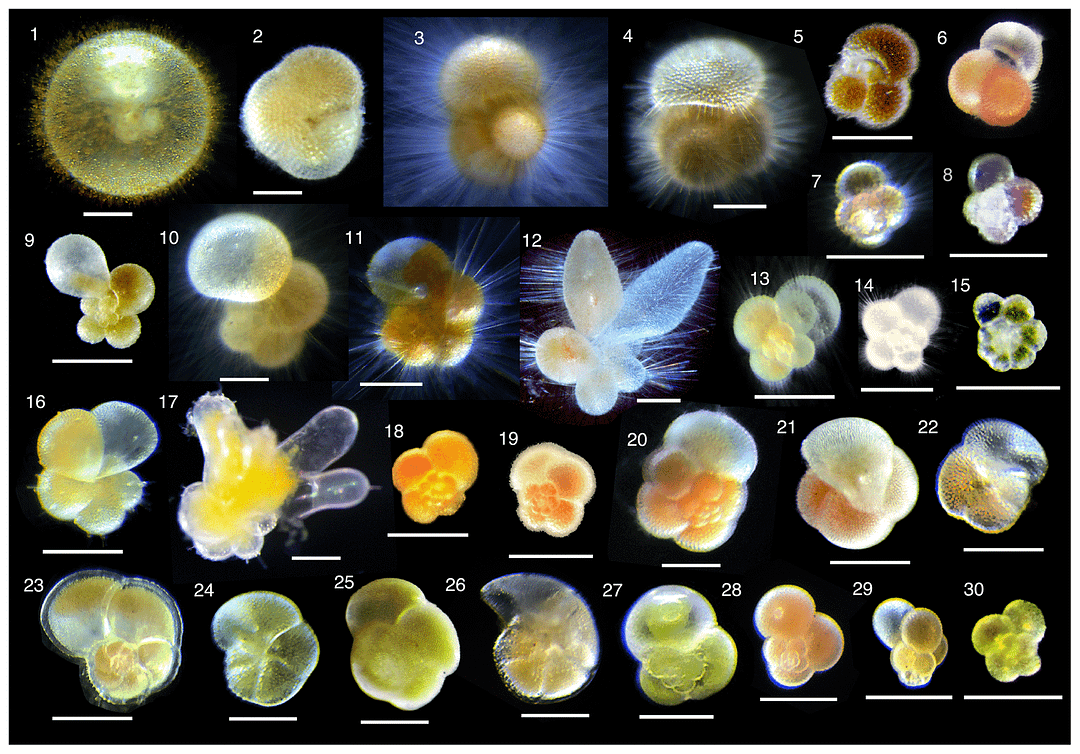
What happens to you, who depend on sunlight for survival?
That question lies at the heart of one of the biggest mysteries surrounding the extinction event that ended the Age of Dinosaurs.
When most people think about the asteroid that struck near present-day Mexico, they picture dinosaurs disappearing from the land. But the impact also affected life in the oceans. In fact, some of the most severe losses occurred among microscopic plankton that formed the foundation of marine food webs.
For decades, paleontologists have known that the extinction was highly selective. Some groups suffered enormous losses. Planktonic foraminifera, the tiny shelled organisms found throughout the world’s oceans, lost the vast majority of their species. Calcareous nannoplankton, another major group of marine plankton, experienced similarly devastating declines.
Other groups fared much better. Diatoms, dinoflagellates, and several other plankton lineages survived in greater numbers.
This pattern raised an important question. If the asteroid created a global environmental crisis, why were some plankton devastated while others survived? At first glance, several explanations seemed possible.
The impact triggered wildfires, acid rain, rapid climate change, and major disruptions to ocean chemistry. Scientists proposed that ocean acidification may have harmed organisms that built shells from calcium carbonate. Others suggested that changes in temperature or nutrient availability may have played a larger role.
All of these processes likely affected marine ecosystems to some degree. The challenge was figuring out which ones mattered most.
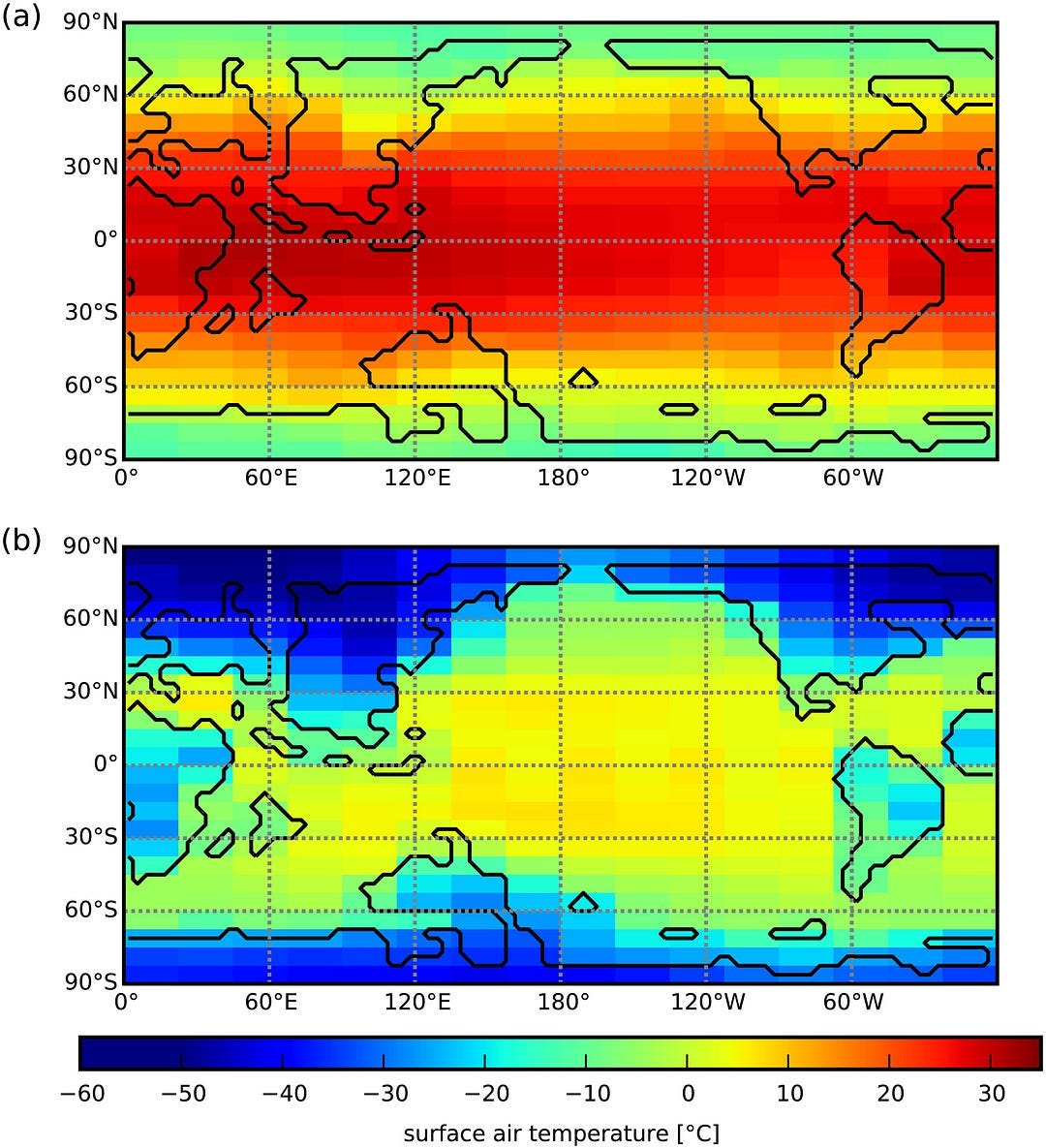
Over the past several years, growing evidence has pointed toward a surprisingly simple answer: a temporary but dramatic loss of sunlight.
Recent climate models suggest that fine dust lofted into the atmosphere after the impact may have blocked a large fraction of incoming sunlight. Photosynthesis nearly stopped across much of the planet. For marine ecosystems, this was a serious problem.
Almost all ocean food webs ultimately depend on photosynthetic organisms. Tiny algae capture energy from sunlight and use it to build organic matter, zooplankton feed on them, and larger animals feed on the zooplankton. Remove sunlight from the system, and the flow of energy begins to slow.
The idea sounds straightforward, but there is an important complication: not all plankton have the same energy requirements.
A small organism needs relatively little energy to stay alive, but a larger organism requires more. Some species can also obtain energy in multiple ways. Certain plankton can both photosynthesize and consume other organisms, giving them additional flexibility when conditions become difficult.
This is where a new study adds an interesting piece to the puzzle.
Rather than focusing on individual species, the researchers built a model containing many different types of plankton with different body sizes and feeding strategies. They then subjected this virtual ecosystem to conditions resembling those expected after the asteroid impact.
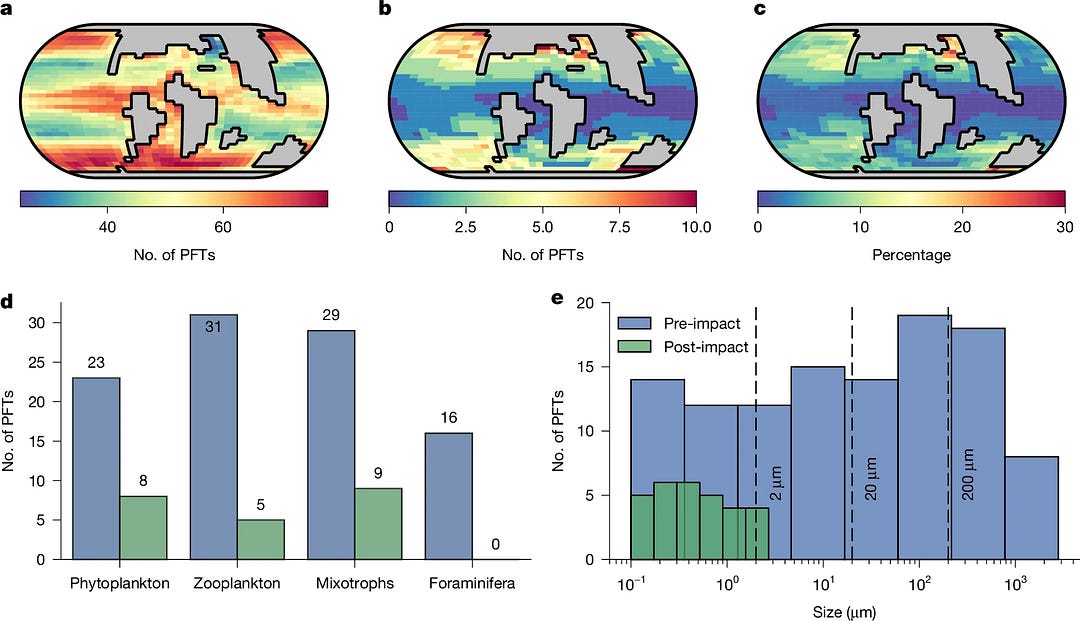
The results suggested that two factors played an especially important role: darkness and body size.
When sunlight disappeared, primary productivity collapsed. The smallest plankton generally survived better than larger forms because their energy demands were lower. Organisms capable of obtaining energy through multiple pathways also performed relatively well.
For planktonic foraminifera, the implications were particularly interesting. Many Late Cretaceous species hosted photosynthetic symbionts, microscopic algae that lived within their shells. Under normal conditions, these partnerships were highly successful. The algae provided an additional source of energy, helping some foraminifera grow larger and occupy stable ecological niches in nutrient-poor tropical waters.
But a prolonged period of darkness may have transformed this advantage into a liability. Without sunlight, photosynthesis stops, and the symbiotic algae can no longer provide energy. Large foraminifera suddenly face the challenge of maintaining their metabolism while one of their primary energy sources disappears.
The fossil record shows that many of these large, symbiont-bearing forms vanished at the end of the Cretaceous. Small opportunistic species were among the survivors.
Importantly, the new study does not prove that darkness alone explains every aspect of the extinction. Earth’s systems are complex, and multiple environmental stresses almost certainly occurred simultaneously. Ocean chemistry and temperatures changed, while ecosystems were disrupted in countless ways.
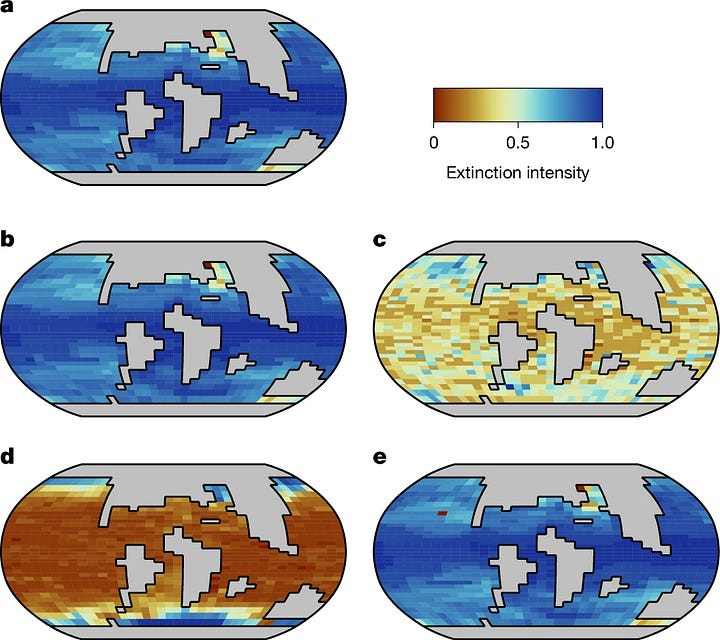
What the study does show is that a relatively short period of severe light reduction may have been enough to explain many of the extinction patterns observed in marine plankton.
That conclusion reflects a broader shift in how scientists think about the event. For many years, discussions of the asteroid impact focused on dramatic environmental disasters such as global fires, acid rain, and rapid climate change. Those processes remain important. But increasingly, researchers are paying attention to something more fundamental.
Energy.
Every ecosystem depends on a continuous supply of energy moving through food webs. The asteroid did not simply alter the climate. It temporarily interrupted the planet’s ability to capture energy from sunlight.
For our hypothetical foraminifer drifting in the tropical ocean, that distinction matters. The shell still offers protection, the ocean still surrounds it, and the currents continue to flow. But the sunlight is gone.
And in a world where nearly all life ultimately depends on photosynthesis, even a temporary interruption can have consequences that echo through entire ecosystems.
Climate Ages has officially become a Substack Bestseller, and it’s thanks to a community of subscribers who believe science writing should stay careful, clear, and accessible.
If you enjoy my work and want to help me keep these stories free for everyone, I’d appreciate your support at any level that feels comfortable:
💡 $1/month or $10/year – A small boost with a big impact.
🌱 $2/month or $20/year – Supporting science communication.
🔬 $3/month or $30/year – Investing in evidence-based insights.
🌍 $4/month or $40/year – Expanding science for everyone.
🚀 $5/month or $50/year – Powering independent science writing.
Every contribution helps me continue creating content that makes science accessible, engaging, and impactful.
With Love,
Silvia P-M, PhD — Climate Ages
P.S. I have exciting news!
I recently launched a second newsletter, The Natural Scientist, focused on careers, purpose, and life in the natural sciences.
If you work in fields like paleontology, ecology, evolution, conservation, museums, or science communication, or know someone who does, feel free to join or share it.
I’ll be covering career paths, interviews, practical advice, and reflections on building a meaningful life around science.
Congratulations for the Bestseller status! Well deserved.
"Small opportunistic species were among the survivors."
A little bit as on land...
Saludos desde Gran Canaria.