

How Did Climate Shape the World Behind The Odyssey?
New climate research explores how gradual drying and natural variability may have increased pressure on eastern Mediterranean societies near the end of the Bronze Age

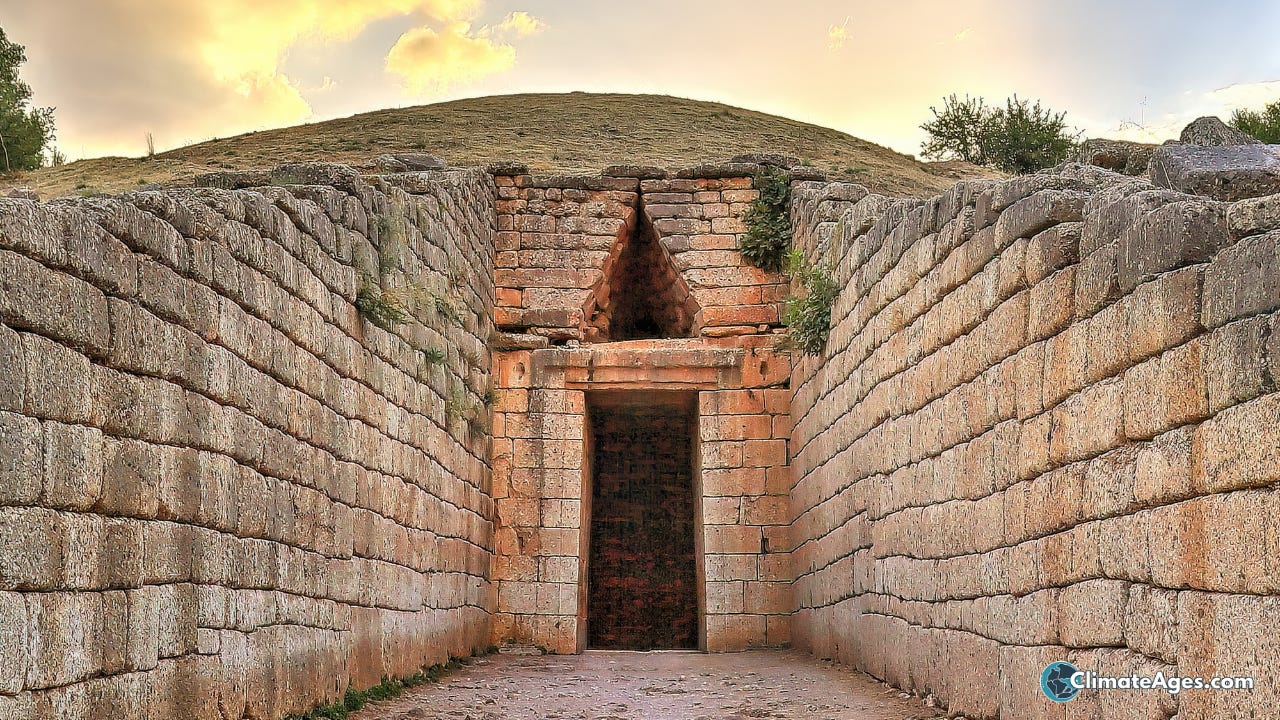
Christopher Nolan’s The Odyssey has brought audiences back to a world of fortified palaces, seafaring warriors, powerful kings, and dangerous journeys across the Mediterranean. The story follows Odysseus as he tries to return home after the Trojan War.
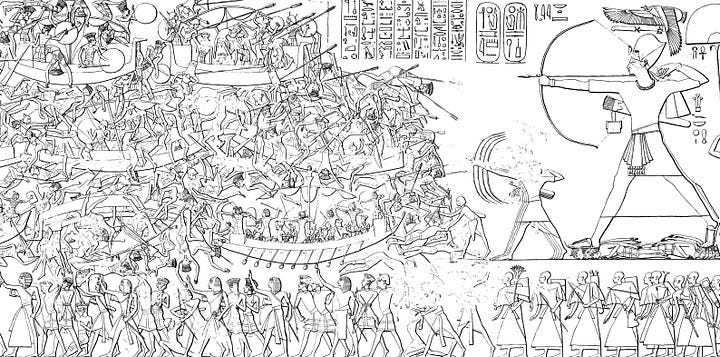
We need to remember, though, that the film is an adaptation of an ancient epic, not a history lesson. Gods and monsters belong to the story, and the poem itself was written down centuries after the period it describes. Still, its setting is traditionally associated with a real and unusually unsettled time near the end of the Bronze Age.
Around 1200 BCE, palace governments in Greece broke down. The Hittite Empire in Anatolia disappeared. Important cities and trade networks across the eastern Mediterranean experienced major disruption. These changes did not happen everywhere at once, and historians still debate why they occurred.
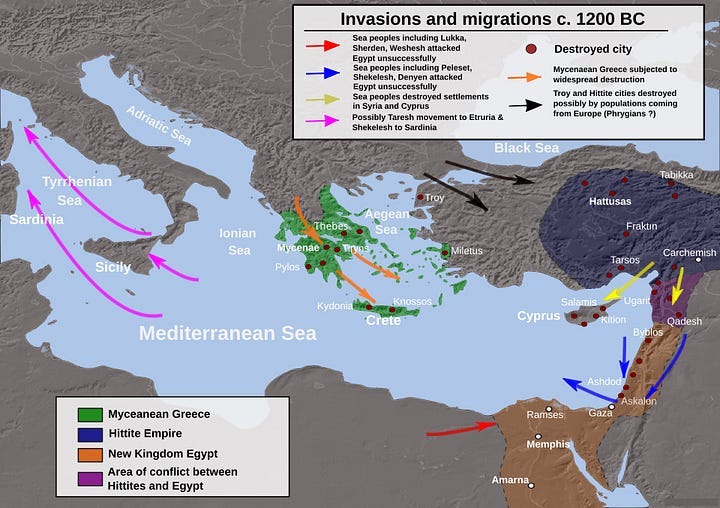
From a scientist’s perspective, though, something else was happening in parts of the region: the climate got drier.
That leaves us with a question that reaches far beyond the Bronze Age. When a society is already dealing with political conflict, warfare, or economic disruption, what happens if the climate adds another source of pressure?
A drought is a shortage of water. A societal collapse is the breakdown of political and economic systems. On paper, one does not automatically cause the other. But under the right conditions, drought can make existing problems much harder to manage.
Imagine that rainfall declines for one year. Farmers may use stored grain, trade for food, or plant something different the following season. Governments can provide assistance. Most societies have ways to manage occasional bad years.
Now imagine that the dry conditions continue. Food reserves shrink. Crops fail in several places at once. Prices rise, trade becomes less reliable, and governments have fewer resources just as more people need help. If war or political conflict is already causing problems, the drought does not replace those pressures. It adds to them.
Archaeologists call the period around 1200 BCE the Late Bronze Age collapse. The name makes it sound like a single event, but the reality was more complicated. Some political systems disappeared, some communities declined, and others reorganized. But not every city was destroyed, and the changes unfolded over different timescales in different places.
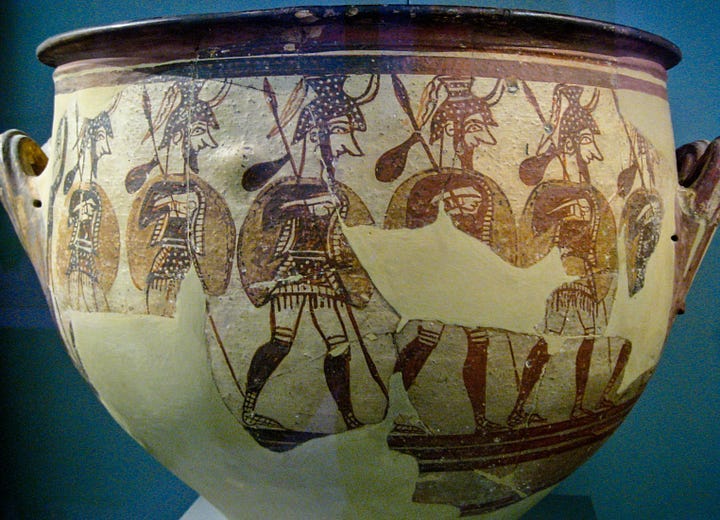
Climate also appears often in discussions about the end of the Bronze Age. Scientists have found evidence of changing moisture conditions in cave deposits, lake and marine sediments, tree rings, and fossil pollen. Together, these records indicate dry conditions in several parts of the eastern Mediterranean, although their timing and intensity varied by location.
Understanding what those conditions meant requires more than measuring rainfall. Much of the eastern Mediterranean receives most of its rain during the cooler months. Summers are naturally hot and dry, so agriculture depends on storing enough winter moisture in the soil to support crops through the growing season.
Temperature affects how long that water remains available. Two years can receive similar amounts of rain but leave farmers with different amounts of water in the soil. Under warmer conditions, greater atmospheric demand can increase water loss through evaporation and plant growth.
Climate scientists account for this using measures such as effective moisture, which compare incoming precipitation with potential water loss. Lower rainfall does not always produce a matching decline in soil moisture. If temperatures also fall, reduced evaporation can partly compensate for the missing rain. If conditions become warmer, the same rainfall can leave the soil drier.
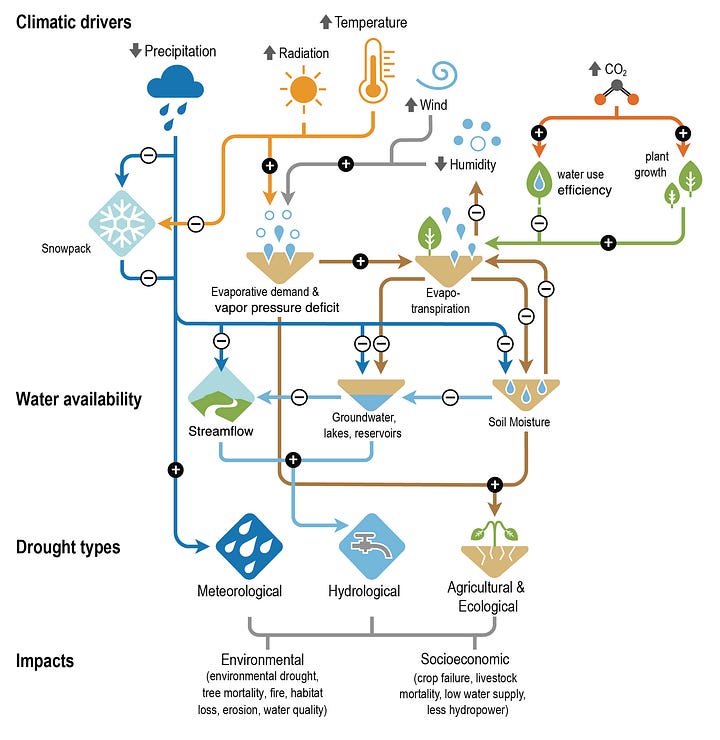
This relationship is well established in modern climate science. The Intergovernmental Panel on Climate Change identifies temperature, rainfall, evaporation, soil moisture, and water storage as connected parts of drought development. It helps explain why rainfall alone cannot tell us how much water was available to ancient farmers.
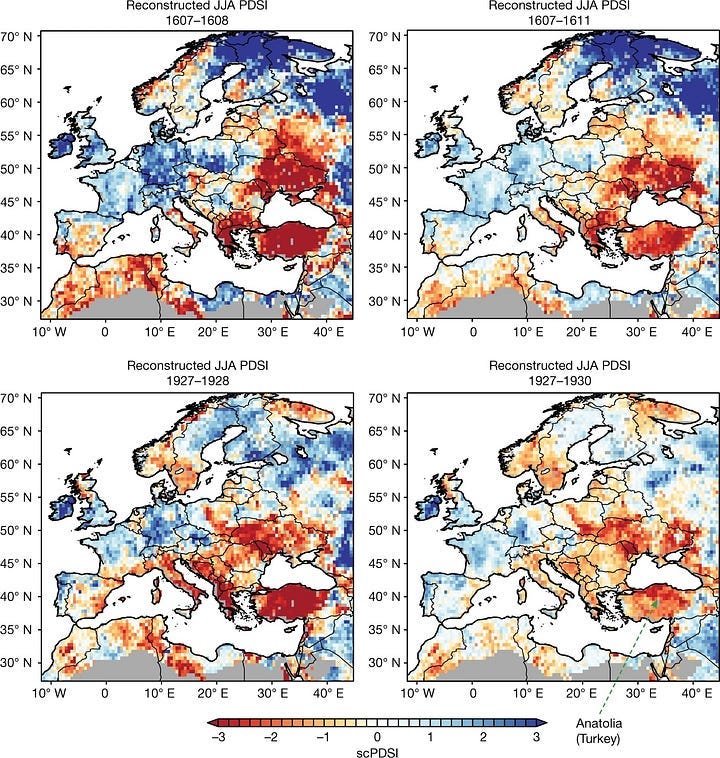
Natural records provide evidence that this balance changed near the end of the Bronze Age. One of the most precisely dated examples comes from ancient juniper wood in central Anatolia. In a 2023 study published in Nature, researchers used tree-ring width and carbon isotopes to reconstruct growing conditions near the end of the Hittite Empire.
They identified an unusually severe dry period from approximately 1198 to 1196 BCE. Three consecutive years of intense water stress would have been more difficult to manage than an isolated dry year. The researchers proposed that this episode may have exceeded systems that had previously helped the Hittites cope with ordinary variations in climate.
The tree rings provide detailed evidence of what happened in one part of Anatolia. Other records extend the picture across the region, but they also reveal local differences, which creates another question: what could produce severe drought across parts of the eastern Mediterranean while causing different environmental changes from one place to another?
Natural records cannot answer that question easily on their own. A stalagmite or lake core can preserve evidence of changing moisture at a particular site, but it cannot fully reveal how shifts in Atlantic circulation, Mediterranean temperatures, monsoons, and atmospheric pressure interacted across thousands of kilometers.
That is the puzzle Dr. Katherine Power and Dr. Qiong Zhang address in a new study published in Science Advances. They analyzed an 8,000-year climate simulation to investigate both the gradual evolution of eastern Mediterranean climate and the shorter fluctuations capable of producing severe drought.
The model includes the atmosphere, oceans, soils, and vegetation. It allowed the researchers to follow physical connections that are difficult to reconstruct from separate natural records. They could examine how changes in sunlight affected monsoons, how Atlantic conditions influenced the Mediterranean, and how temperature altered the balance between rainfall and water loss.
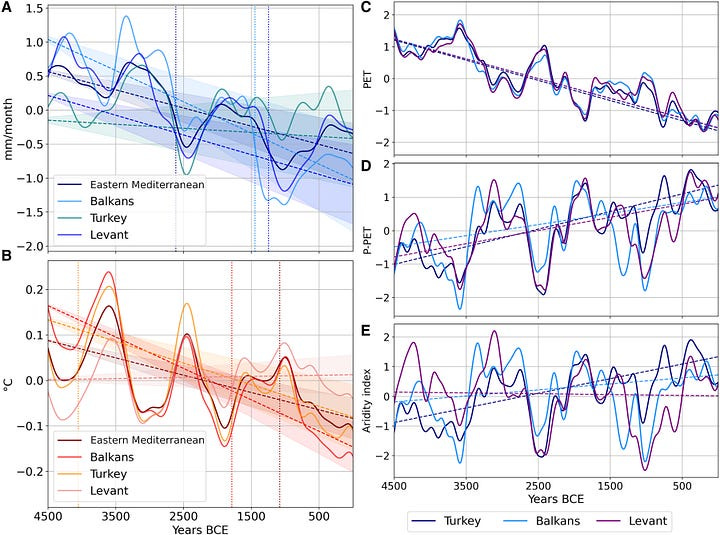
Their results show that the region did not move uniformly toward greater dryness. Instead, slow changes in Earth’s orbit reduced Northern Hemisphere summer sunlight over thousands of years. This weakened major monsoon systems and reduced the transport of moisture toward the Mediterranean.
Rainfall declined in parts of the region, but that did not produce the same result everywhere. In the Balkans and parts of Anatolia, temperatures also fell. The cooler conditions reduced evaporation, sometimes improving effective moisture even as rainfall declined. The model simulated an expansion of trees in these northern areas.
The Levant received less benefit from cooling and remained persistently dry. Its vegetation continued to be limited primarily by rainfall. The same broad climate changes therefore produced different results across neighboring regions.
This finding helps explain why evidence for Late Bronze Age drought is not identical at every archaeological or natural site. The eastern Mediterranean is not one uniform climate zone. Local temperature, rainfall, vegetation, and geography shaped how much water remained available.
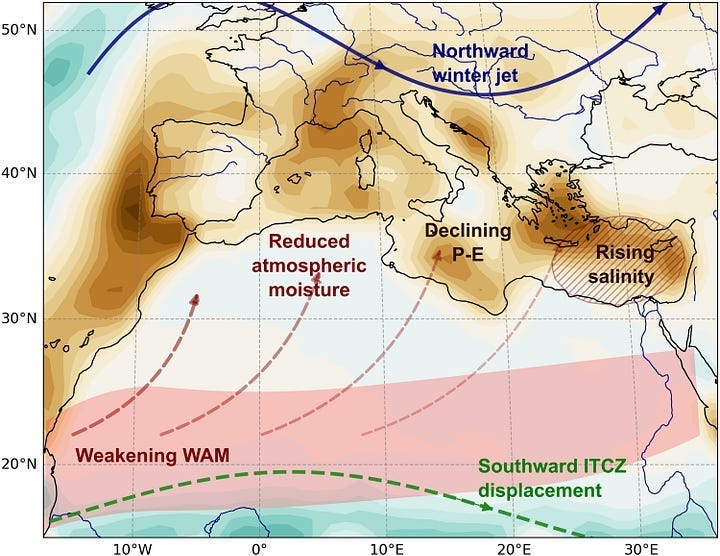
The authors then examined the severe droughts that interrupted these gradual changes. Atlantic and Mediterranean conditions naturally vary over decades and centuries. Usually, these variations do not reach their driest stages at the same time.
In the simulation, they occasionally did. When several dry phases aligned, they reinforced one another and produced a drought more severe than any individual variation would have created alone. One of these modeled droughts occurred near the interval associated with the Late Bronze Age transition.
This does not mean the simulation recreated the historical drought year by year. It shows that the climate system could produce a drought of similar severity through the processes identified by the study.
The study’s central contribution is therefore not a new claim that climate caused the Late Bronze Age collapse. It is a mechanistic explanation of how gradual environmental change and shorter natural variations could combine to produce an unusually severe drought.
Whether that drought became a political crisis depended on people and institutions. The climate model does not contain wars, rulers, trade negotiations, grain distribution, or decisions about who received assistance. Archaeology and history are still needed to explain why some political systems disappeared, while other communities adapted.
The same distinctions matter today. Human-caused warming is increasing atmospheric water demand in the Mediterranean. Higher temperatures can dry soils more quickly, which means that rainfall totals alone may not describe the amount of water available to farms and ecosystems. Under this scenario, natural variability can then temporarily strengthen or weaken those underlying changes.
This does not make social disruption inevitable. Modern forecasting, irrigation, crop selection, food storage, trade, and effective government can reduce the consequences of drought. The environmental hazard matters, but so does the capacity to prepare for it and respond.
The Odyssey tells a story about the difficult journey home after a legendary war. Climate science cannot tell us whether Odysseus existed or how accurately Homer’s world reflects the Bronze Age. But it can help reconstruct the environmental conditions experienced by real communities living across the region during that broad period.
Drought did not need to bring down an empire by itself to matter. It only needed to make food production, trade, and political decisions more difficult at an already demanding time. The new study helps explain how such a drought could have developed. The rest of the explanation lies in how different societies responded.

Follow for more stories in Paleontology, Ecology, Conservation, and Climate Change!
Climate Ages has officially become a Substack Bestseller, and it’s thanks to a community of subscribers who believe science writing should stay careful, clear, and accessible.
If you enjoy my work and want to help me keep these stories free for everyone, I’d appreciate your support at any level that feels comfortable:
💡 $1/month or $10/year – A small boost with a big impact.
🌱 $2/month or $20/year – Supporting science communication.
🔬 $3/month or $30/year – Investing in evidence-based insights.
🌍 $4/month or $40/year – Expanding science for everyone.
🚀 $5/month or $50/year – Powering independent science writing.
Every contribution helps me continue creating content that makes science accessible, engaging, and impactful.
With Love,
Silvia P-M, PhD — Climate Ages
I really liked this. Been interested in Homer for ages, have three translations each of the Iliad and Odyssey, and agonized whether to love/hate Schliemann for what he did to the site of Troy (probably). Great to have a historical context.