

Climate Is Changing the Planet. Is Nature Keeping Up?
What 100 Years of Biodiversity Data Reveal About How Ecosystems Respond

Imagine you return to a town you lived in twenty years ago. You expect change. New traffic lights. Better roads. Maybe a new supermarket and trending restaurants. If you go back a hundred years, the difference should be even greater. Horse carts replaced by cars. Telegraph wires replaced by fiber optic cables. Now perhaps electric vehicle charging stations.
But sometimes that is not what you find.
Sometimes a town does not “keep up.” Investment slows. Businesses leave. Infrastructure ages. Change becomes patchy and uneven. Growth depends not only on outside pressure, but on whether the system itself has the capacity to respond.
For decades, ecologists have assumed something similar about nature. That, as the climate changes, ecosystems should change with it. If temperatures rise faster, species should shift faster. If rainfall patterns move, plant and animal communities should reorganize. The logic seems straightforward. Faster environmental change should mean faster biological change.
Yet the story of how ecosystems change is more complex than that.
In ecology, there is a concept called species turnover. It simply means the replacement of species in a given place over time. Imagine a forest. Ten years later, some species are gone, and others have arrived. That is turnover. It happens in grasslands, coral reefs, rivers, and even your backyard. It is not necessarily a sign of damage. In many cases, turnover reflects the natural reshuffling of life.
For a long time, scientists have debated what drives this reshuffling. One side points to environmental change. When temperature or rainfall shifts, species that are better adapted move in, and others move out. The other side emphasizes intrinsic dynamics. That means internal processes within ecosystems. Species compete. They colonize new patches. They disappear locally and return later. Even in a stable climate, communities are not static.
Both ideas have strong evidence behind them.
We know that climate can influence where species live. We have clear examples of animals shifting toward the poles or higher elevations as temperatures rise. At the same time, long-term field studies show that communities can change even when the climate remains fairly constant. Ecological communities are not fixed lists. They are dynamic networks.
To untangle these drivers, scientists have often asked a simple question. As climate change accelerates, are ecosystems changing faster?
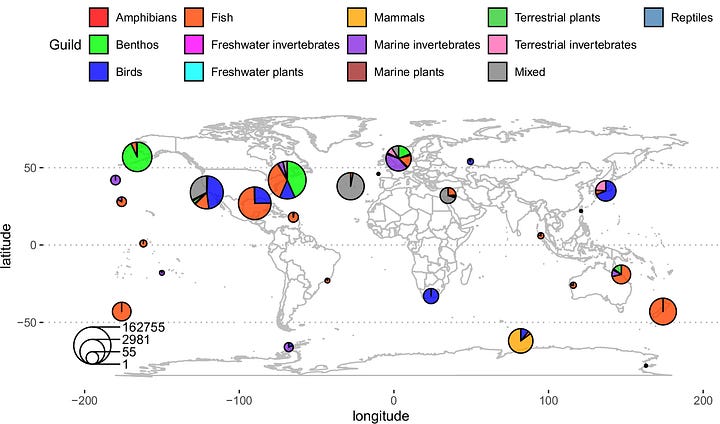
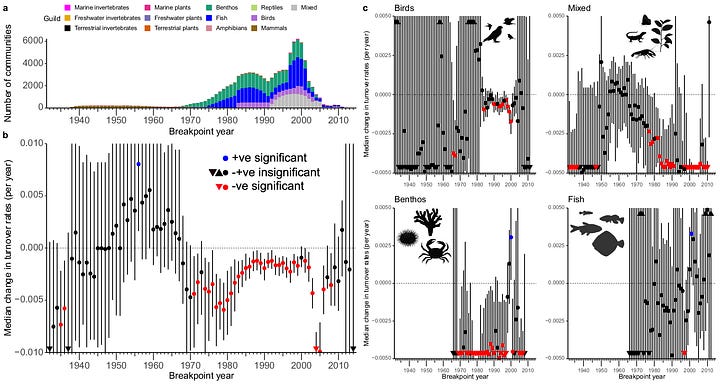
A recent study by researchers at the Queen Mary University of London tackled that question using one of the largest biodiversity databases available, the BioTIME database. It includes long-term surveys of plants, fish, birds, invertebrates, and other organisms from around the world. Instead of focusing on one forest or one reef, the researchers examined thousands of community time series spanning much of the past century.
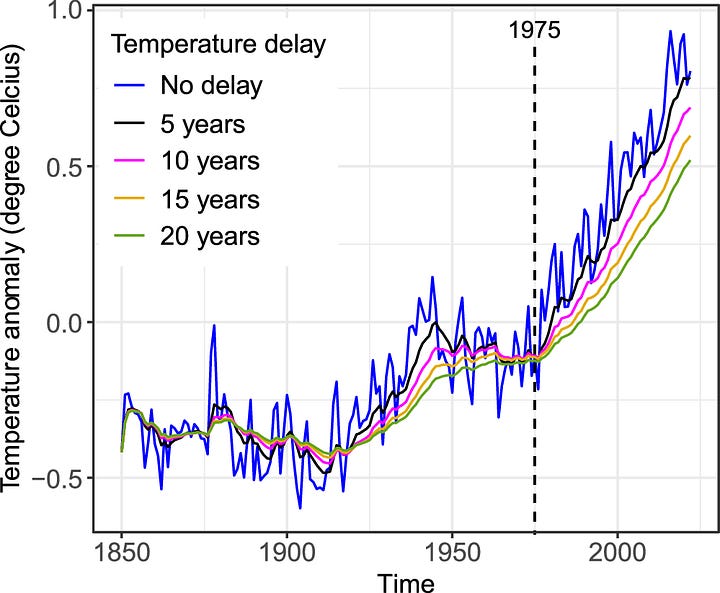
Here is what they expected. Since global temperatures have increased more rapidly in recent decades, short-term species turnover should also have sped up. If climate is the main driver of change, the rate at which communities reshuffle over a few years should be faster now than it was fifty years ago.
That is not what they found.
Across many ecosystems, short-term turnover over intervals of one to five years has slowed rather than accelerated. In fact, the median rate of turnover declined by about one third after the mid-1970s compared to before. This pattern appeared in birds, benthic marine communities, and mixed terrestrial systems. Fish communities showed less consistent patterns, possibly because fishing regulations, stock management, and harvesting pressure directly influence fish populations, adding a layer of human control that can mask broader ecological signals.
The result does not mean ecosystems are stable. It means that, over short time spans, the pace of replacement has not increased in step with warming. That is surprising if climate shifts are assumed to dominate the process.
To understand why this might happen, it helps to return to our town analogy. A town may face increasing economic pressure, but if it loses businesses and population, its capacity to respond can shrink. Fewer investors. Fewer workers. Less movement. Change slows, even though outside forces continue.
In ecological terms, turnover often depends on colonization. New species arrive from a regional pool. They establish, compete, and sometimes replace others. If the regional species pool shrinks, or if habitat fragmentation reduces movement between areas, the number of potential colonizers declines. Even if the climate is shifting, there may simply be fewer candidates ready to move in.
The researchers explored this idea using a community model. In their simulations, faster environmental change did increase turnover. But when they added environmental degradation, modeled as a general reduction in species growth rates, turnover slowed. The reason was straightforward. A degraded environment supports fewer viable species. Fewer viable species mean fewer successful colonizations. Less colonization leads to slower reshuffling.
This explanation does not deny climate effects. It suggests that multiple processes operate at once. Environmental shifts can push communities to reorganize. At the same time, habitat loss, pollution, and fragmentation can reduce the pool of species capable of responding.
Importantly, the study focused on short-term turnover. Over longer time scales, climate-driven shifts may become more dominant. Other analyses have shown that when you look at decades rather than a few years, temperature change correlates more clearly with biodiversity turnover. The time scale matters.
What I find compelling about this work is not that it overturns previous knowledge, but that it reminds us how layered ecological change can be. When I have worked on conservation projects, I often saw communities that were clearly under pressure. Yet the way species lists changed from year to year did not always match our expectations. Sometimes altered habitats showed less change than more intact ones. That observation fits with the idea that healthier systems may have more movement and exchange.
Species turnover is not inherently good or bad. It can signal resilience, connectivity, and a large regional species pool. Or it can signal disruption. The key is understanding the mechanism behind it.
The broader lesson is about how we interpret change. Just as infrastructure growth depends on more than outside demand, ecosystem dynamics depend on more than climate trends. Internal structure, connectivity, and overall environmental condition shape how communities respond.
When we ask whether nature is keeping up with climate change, we need to consider not only the speed of warming, but also the biological capacity for movement and replacement. The recent study adds an important piece to that puzzle. It suggests that, at least over short time spans in the past century, intrinsic ecological processes and environmental degradation may have played a larger role than simple climate acceleration.
The dynamics of biodiversity change are not a single line rising or falling. They are a combination of drivers interacting across scales. Recognizing that complexity does not weaken our understanding. It strengthens it, helping us better prepare for an uncertain future.
Thank you for supporting independent science writing.
Climate Ages has officially become a Substack Bestseller, and it’s thanks to a community of 100+ paid subscribers who believe science writing should stay careful, clear, and accessible.
If you enjoy my work and want to help me keep these stories free for everyone, I’d appreciate your support at any level that feels comfortable:
💡 $1/month or $10/year – A small boost with a big impact.
🌱 $2/month or $20/year – Supporting science communication.
🔬 $3/month or $30/year – Investing in evidence-based insights.
🌍 $4/month or $40/year – Expanding science for everyone.
🚀 $5/month or $50/year – Powering independent science writing.
Every contribution helps me continue creating content that makes science accessible, engaging, and impactful.
With Love,
Silvia P-M, PhD — Climate Ages
In the human world, population growth combined with available resources and functioning organizational structures = growth of the built environment and a general improvement in the standard of living. Take away or seriously degrade one or more of those factors and you have a civilization unable to adapt to change, unable to grow and not capable of improving the standard of living.